

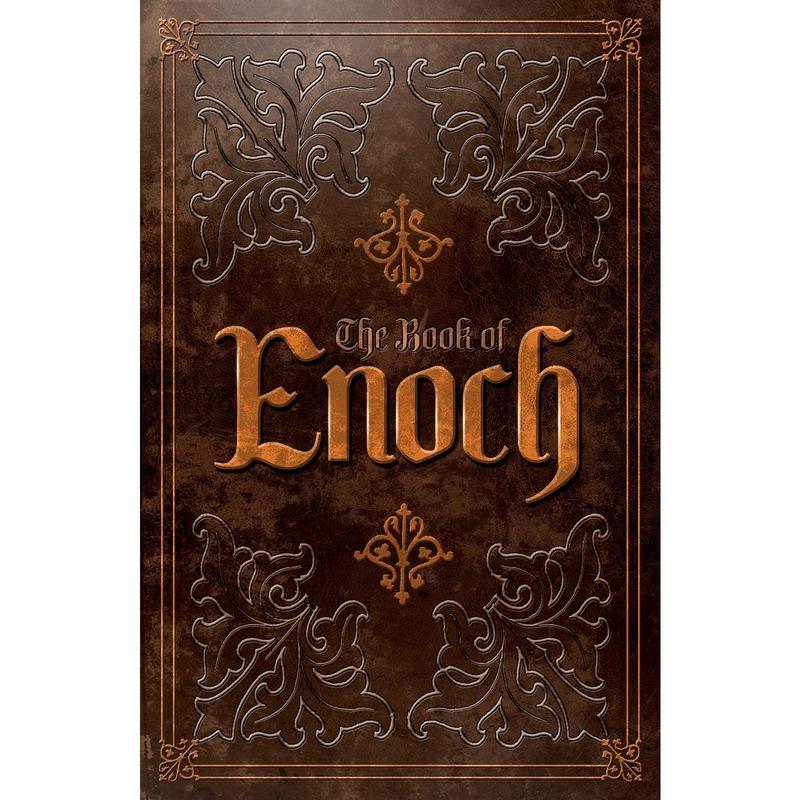








The Book of Enoch: - Hardcover - Ancient Mystical Texts of the Fallen Angels and Hidden Revelations
The Bible, as we hold it today, is esteemed by many religious institutions and especially Conservative Christians to be the inspired, inerrant Word of God.
(1).gif?w=240&h=426&_f=1)
The Authority of the Biblical Canon
Within historic Christian orthodoxy, the Bible is regarded as the inspired and authoritative Word of God. As stated in 2 Timothy 3:16–17, Scripture is described as divinely inspired and profitable for doctrine, correction, and instruction in righteousness. This doctrinal affirmation distinguishes the canonical Scriptures from all other religious literature in terms of theological authority.
The present volume does not challenge that canonical distinction. Rather, it presents The Book of Enoch (1 Enoch) as an important ancient Jewish text that contributes to understanding the intellectual and theological environment in which portions of the Old and New Testaments were written.

Historical Background of 1 Enoch
The Book of Enoch is an ancient Jewish apocalyptic work traditionally attributed to Enoch, described in Genesis as the great-grandfather of Noah and “the seventh from Adam.”
Most scholars conclude that 1 Enoch was composed in stages, likely beginning in the 3rd century BCE. The text was originally written in Aramaic, and fragments of it were discovered among the Dead Sea Scrolls, dating to approximately the 2nd century BCE.
This places the composition of 1 Enoch squarely within the Second Temple Period (ca. 500 BCE – 70 CE), a formative era for Jewish theology and the intellectual backdrop of early Christianity.

Canonical Status and Ecclesiastical Reception
The canonical status of 1 Enoch varies across Christian traditions.
It is recognized as canonical Scripture within the
Ethiopian Orthodox Tewahedo Church
Eritrean Orthodox Tewahedo Church
However, the majority of Christian denominations regard it as non-canonical. In those contexts, the text is valued for its historical, theological, and literary significance rather than for doctrinal authority.
In academic settings, 1 Enoch is frequently assigned in courses addressing:
Second Temple Judaism
Apocalyptic literature
Dead Sea Scroll studies
New Testament background

The Watcher Tradition and Genesis 6:1–4
One of the most significant contributions of 1 Enoch is its expansion of the brief narrative found in Genesis 6:1–4, describing the “sons of God” (Hebrew: beney ha-elohim) and the “daughters of men.”
While Genesis provides only a concise account, 1 Enoch develops this episode extensively through what is commonly referred to as the “Watcher” tradition. In this interpretive expansion, the Watchers represent divine beings whose transgression contributes to the corruption preceding the Flood narrative.
Scholars note that this expanded account reflects broader ancient Near Eastern literary and theological motifs, including Mesopotamian parallels. In contrast to the brevity of Genesis, 1 Enoch presents a systematic retelling that preserves and elaborates upon these cultural touchpoints.
This material is of particular importance for researchers examining:
- The development of angelology and demonology
- Intertestamental interpretations of Genesis
- The intellectual milieu of early Jewish apocalypticism

New Testament Reception
The Epistle of Jude (Jude 1:14–15) contains a direct citation of 1 Enoch, attributing a prophetic statement to “Enoch, the seventh from Adam.” This reference demonstrates that at least some early Christian authors were familiar with, and influenced by, Enochic traditions.
For this reason, 1 Enoch is frequently examined in studies of New Testament theology, especially in relation to:
- Angelic hierarchies
- Eschatological judgment
- Cosmic rebellion narratives
Scholarly Assessment
Biblical scholar Michael S. Heiser, in his work Reversing Hermon, emphasizes the importance of Enochic literature for understanding the supernatural worldview reflected in portions of the New Testament.
Contemporary scholarship broadly recognizes 1 Enoch as one of the most significant non-canonical Jewish texts for reconstructing Second Temple theology and its influence on early Christianity.
Academic Significance
While 1 Enoch does not occupy canonical status in most Christian traditions, it remains indispensable for:
- Contextualizing Genesis 6 within ancient Jewish interpretation
- Understanding the theological development of angelology
- Examining the background of certain New Testament citations
- Reconstructing Second Temple Jewish cosmology and eschatology
For scholars, clergy, graduate students, and serious researchers, The Book of Enoch serves as a critical primary source for historical-theological inquiry into the intellectual world of early Judaism and Christianity.
Product Details
Print length: 104 pages
Dimensions: 6 x 0.6 x 9.1 inches
Pack: The Book of Enoch x 1
Shipping & Delivery
1. Shipping cost:
Standard Shipping: 0 - 49.99 $5.00
Free Shipping: Orders over $50.
2. Delivery Time:
Delivery Time=Processing Time+Shipping Time
Processing Time: 3-7 Working Day
Shipping time: 10-15 Working Days(not calendar days)
Note: During peak seasons and promotional sales, delivery might take a little longer.
3. Where does ideabookes deliver?
U.S: We ship orders to all 50 U.S. states (and Washington D.C.) Monday – Friday, except public holidays. Please note that we do not ship to APO/FPO/DPO addresses.
United Kingdom: We ship orders to all areas United Kingdom Monday – Friday, except public holidays. Please note that we do not ship to APO/FPO/DPO addresses.
Australia: We ship orders to all areas Australia Monday – Friday, except public holidays. Please note that we do not ship to APO/FPO/DPO addresses.
4. How can i track my order?
Our delivery time starts from the moment an order is accepted and includes a 24-hour period where your items will be processed and dispatched on business days. Please note: this can take longer during promotional sales.
As soon as your order is packed we will send you a shipment confirmation email with the delivery information and a link to track your order online. Please note, that it can take some days before the tracking information is available.
5. What should I do if the delivery is delayed/What if my package is lost
Our parcels are delivered by logistics companies, which can track the logistics status in real time, but if the delay/loss is caused by irresistible reasons, we are also deeply sorry, we can do the following:
A, Maintain communication with the our service
The last thing we want to see is that your package has been delayed. Make sure we know the status of the package. We will keep in touch with you at any time and let you know the status of the package. And explain the situation to you.
B. Track your goods in real time
When you notice a delay at any time during the shipment process, you can take some form of action: send a replacement package in a faster way. Or, if there is a delay and you are anxious to get the package, you can contact us, and we may re-issue the package using other shipping methods according to the situation.
6. About cancel your order
You can cancel your order, we accept order cancellations before product processing. If the order is canceled by that time, you will get a full refund.But If the product has already been shipped out, we will unfortunately be unable to cancel the order. Thank you for your understand!
Note: You will be notified by email once the order has been sent. So it is can not to cancel the order after the goods have been shipped. If you insist that you do not want your package, you can contact us to return it after you receive it. Thank you for your understand!
If you have any question,You can contact us directly: serve@ideabookes.com
RETURN EXCHANGE
Return & Refund Policy
Welcome to ideabookes. We focus on the pursuit of product quality and excellent customer service. We are committed to providing a comfortable and peaceful purchase experience for each customer. But Please to make sure the recipient's name, delivery address and phone number are correct, otherwise we will not be responsible for lost goods.
Please note: Sale and promotional items are excluded and remain subject to our regular return/exchange policy.
1, Cancellation
If you want to cancel the order, please contact our customer service within 6 hours after placing the order and before the goods are shipped. We cannot cancel the order while the package is in transit. Thank you for your understanding.
2, Return & Exchange Conditions
• Returned within 30 days of receipt
• All items in original packaging with all parts and components
•All items in new condition with no damage or cut wires
•Return/Exchange shipments must be made using the same service as the original delivery.
•We can only accept returns/exchanges from the country to which an order was originally shipped, for example, orders delivered to the US must be returned from the US
Note:Any items that do not meet the above criteria will be subject to a restocking fee. After we receive the return,Credits will be issued using your original payment method, please allow up to 30 days for return and refund.
Kindly note:
We can accept your return, but not free for any reason. If there is something wrong with the quality of our products, we sent it wrong or missed it, we will give you a refund or replace the products.
But we are not responsible for these reasons, If your return is for any of the following reasons, please bear the return freight by yourself (Hope you can understand, thank you.)
• Items that have been installed or assembled
•Items that are not in the original condition and packaging
•Items that are Made-to-Order, Custom or Special Order to your specifications
•Items or packages damaged without any proof from local logistics
•Any items or style not listed on our website
Note: Return address: Please contact us and we will send you the return address once you decide to return the goods.
3, Refund
In case of a return, your refund will be credited to the original payment method. Shipping costs will not be refunded by Paxcang in case of returns.
Once your package reaches us, please allow 7-14 business days (depending on peak times) for your return to be processed. If your return does not meet the conditions listed, the package will be sent back to you at your own expense. When your return has been accepted, your refund will be issued and you will receive a confirmation email.
4,Damage
We assume full responsibility for products that have been defective due to incorrect packaging, any obvious damage to your products on arrival or during transportation. Please check the packaging when you receive the goods. If you find any damage, please record it when you sign for it. If the items in the package are damaged on arrival, please send the photos to support@.com and we will handle the insurance claim on your behalf.
5, How to return an item or an entire order?
Step 1: Please contact our Customer service team to start the return process with the following information:
Order number
Proof of purchase
Video or photo of the faulty product
Step 2:
1.Put the product into a bubble bag, then into a packaging bag, and then stick the logistics label on the packaging bag before shipping.
2.Customers are responsible for the return shipping costs.
3.Return Address:No. 888, Longtougang 2nd Road, Linkong Economic Zone, Xinjian District, Nanchang City, Jiangxi Province(This is our overseas factory)
Return/Exchange Address: Please contact customer service
To return any items, please contact:serve@ideabookes.com